


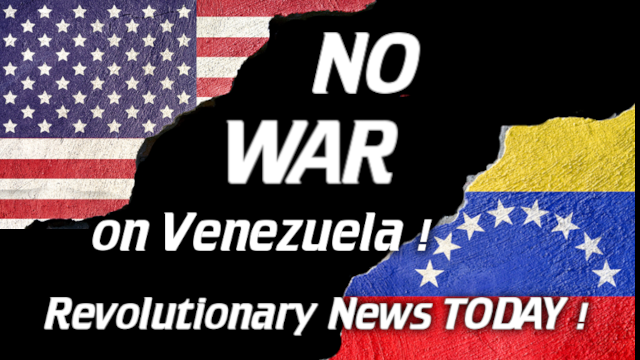
Why is the U.S. Threatening
WAR on Venezuela?
It’s not Drugs, It’s Oil and Blue Gold…
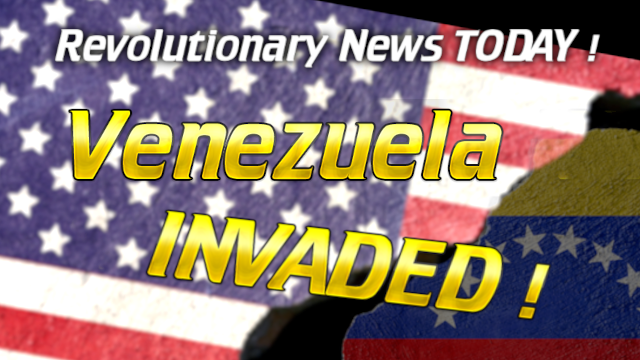
U.S. military forces are growing in the Caribbean. There are currently 10,000 troops, an amphibious assault ship loaded with Marines, eight warships off the shores of Venezuela and an aircraft carrier battle group is on the way. Since September, the U.S. has sunk 16 civilian boats and murdered over 70 people. Trump has approved the bombing of Venezuela and sent covert troops and CIA assassination teams into the country.1
Why attack Venezuela? Trump tells us that he is fighting “narco-terrorists” and keeping America safe. Everyone knows he is lying. The real target is control of Venezuela’s “Blue Gold”.
The U.S. needs Coltan, Venezuela’s ‘blue gold’. Coltan is the source of tantalum a rare earth metal essential in the manufacture of electronic systems including guidance control systems in smart bombs, on-board navigational systems in drones, and most modern weapons systems.2,3 U.S. has no domestic source of coltan. Venezuela has deposits worth over $100 billion.2
The people of Venezuela control their natural resources. They believe that the wealth of their country should be used for the benefit of the people of Venezuela, not to increase the wealth of American billionaires.
To get their hands on Coltan, the American government and the 1% who control it must take over Venezuela. Since Hugo Chavez’s election as President of Venezuela in 1998, the U.S. has attacked the country diplomatically, economically and militarily. It does not matter if the President is a Democrat or a Republican. In 2015, Obama claimed that Venezuela posed an “unusual and extraordinary threat” to US security and increased sanctions on the country.3
The U.S. has a long history robbing the peoples of South and Central America by threatening violence and using violence. In the words of Marine Corps Major General Smedely Butler,
I spent thirty-three years in the Marines, most of my time being a high-class muscle man for Big Business, for Wall Street and the bankers. In short, I was a racketeer for capitalism. I helped make Mexico, especially Tampico, safe for American oil interests in 1914. I helped make Haiti and Cuba a decent place for the National City Bank boys to collect revenues in. I helped in the raping of half a dozen Central American republics for the benefit of Wall Street.4
The US government says it wants to restore democratic rights in Venezuela. As Gen. Butler points out, what they really want is to make it easy for the capitalists to steal the wealth and freedom of the Venezuelan people and to rape the environment for profit.
The US forces are poised to bring Capitalist democracy to Venezuela where the 1% – who own AI, the media, mines, banks, etc. – are free to squeeze every last penny out of the working class – the 99% who create the wealth.
The working class is at war with the capitalist class. It is a fight between those of us who supply the collective labor that produces wealth and the private owners who steal that wealth.
It is a fight for Working Class democracy where the wealth of our planet is used to provide everyone with what they need to live a healthy and productive life, a just and peaceful world based on cooperation.
The American people and the Venezuelan people are fighting for the same future.
We, the American people, must stop the WAR on Venezuela not only because it is the right thing to do but because ANYTHING THAT SRENGTHENS OUR ENEMY WEAKENS US.
We can do this, we must do this.
- https://www.newsweek.com/satellite-photo-us-ramping-military-pressure-venezuela-11007986
- https://venezuelanalysis.com/analysis/11372/
- https://investingnews.com/what-is-coltan-mineral-uses/
- “War Is a Racket”, https://www.heritage-history.com/site/hclass/secret_societies/ebooks/pdf/butler_racket.pdf)

About The Author