

![- Revolutionary News Today! Candle Memorial with Flowers and a 'justice 4' Sign; Bold Overlay Text Reads 'i.c.e. is Above the Law' and 'terrorism in Austin, Texas'.]} } Non-senseoops. Need Proper Array. Let's Redo.](https://revolutionary-news-today.org/wp-content/uploads/2026/09/RNT-ICE-Texaas-Shooting-1a-150x150.webp "RNT ICE Texaas Shooting 1a REVOLUTIONARY News TODAY")



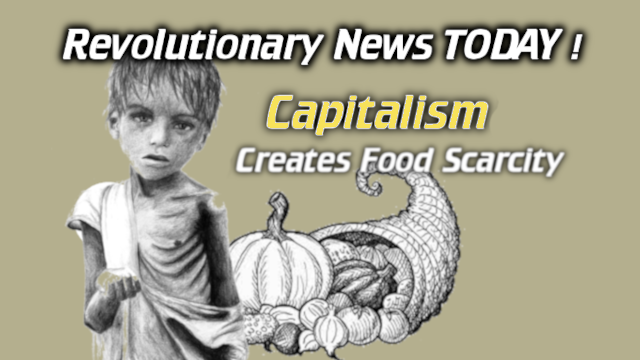
Capitalism and Hunger
What a Peach can teach us about Capitalism
I love peaches. The small and usually hard early-season peaches, as well as the big, juicy ones that appear in the late summer. So, I was upset to learn that California peach growers are going to destroy 420,000 peach trees.1,2
The trees are not being destroyed because they are infected with a disease or infested with bugs. Like just about everything today, the reason is money. Del Monte Foods is closing its Modesto fruit cannery and canceling more than $550 million in long-term contracts with peach farmers. To cut their losses, the farmers need to reduce the number of peaches in order to keep the price high. This is why the trees are going.
What are we losing? On average, 420,000 peach trees will yield 50,000 tons of peaches, which is about 400 million peaches, and, if you like peach pie, about 100 million pies. This is a lot of food that could feed a lot of hungry people.
So why destroy peach trees? Contrary to what we are taught, the majority of the food grown in the U.S. is not meant to feed people; it is produced to make money.
In a capitalist system, a peach is not a fruit; it is not food, it is a commodity.
A commodity is a product of human labor that satisfies a human want and that is produced for sale on the market.4 The value of a commodity is measured by the human labor used to bring it to the market and the amount of money spent in making the product. The price of a commodity is based on supply and demand. If the price of a product is greater than the value, capitalists make money. But if there are too many products in the market (elevated supply) or no one wants them (reduced demand) the price falls, and capitalists lose money.4
Growing peaches requires a lot of human labor; they have a high value. Peach trees need constant thinning, management of insects, and overall maintenance.5 Peach harvesting requires skilled labor because peaches are fragile and must be carefully hand-picked to avoid bruising.5 This work is primarily performed by migrant farmworkers. In California, there are between 500,000 and 800,000 farmworkers, the vast majority of whom are undocumented. Farmworker wages range from $16 to $19 per hour or between $35,000 and $37,000 per year.6 The poverty line is $33,000 for a family of 4 and $38,000 for a family of 5.
The situation for the peach growers is quite simple: 1) The loss of the contract with Del Monte Foods reduces the demand for their product, creating excess supply and, therefore, reducing the price. 2) They are already paying the farmworkers a poverty wage, so they cannot reduce the value of their peaches. 3) The only market capitalist solution is to destroy the peach trees, reduce the supply of peaches, which will increase the price.
This is the way capitalism works. Even though there are hungry people in the U.S., the farmers must destroy 400 million peaches to survive.
How can we solve this problem?
The government’s solution is to give the farmers $9 million to help destroy trees. The money comes at the request of Senator Adam Schiff, a “progressive” Democrat, and the California congressional delegation. Save the farmers and screw the people.
Our solution, Share-and-Share-Alike Socialism. We can give the 420,000 peach trees and a $550 million government contract to the farmworkers, and then give the peaches to the hungry. It is the farmworkers’ labor that adds value to the peaches. They should receive fair compensation for their work. Isn’t it better to spend $550 million producing food for the hungry than on 1 day of war on Iran, or 4,000 bombs for Israel’s genocide in Gaza?
Can this work?
In Maine, there is an organization called Fishermen Feeding Mainers.7 It began in late 2020 and raises money to buy locally caught fish, process them, and donate the frozen fillets to schools and food banks in Maine. The organization has donated more than 1.8 million meals to food banks, schools, and other institutions since October 2020. Last year alone, the program gave away over 200,000 meals. So far, it has spent more than $4 million on the purchasing and processing of about 1.3 million pounds of locally caught fish. Elon Musk earns over $90 million a day; just think of what Fishermen Feeding Mainers could do with that money.
What we are talking about is a new economic system based upon public ownership and distribution for the benefit of all. We are talking about Share-and-Share-Alike Socialism – From each according to their ability, to each according to their needs.
Think about this, then next time you bite into a peach.
References
- https://www.modbee.com/news/business/agriculture/article314347977.html
- https://finance.yahoo.com/economy/policy/articles/california-farmers-must-destroy-420-202332529.html?guccounter=1
- https://growingfruit.org/t/how-many-peaches-should-i-let-my-3-4-year-old-peach-trees-give/37646
- Karl Marx, Value, Price and Profit, 1865.
- https://cafarmtrust.org/peaches-theyre-a-ca-thang/
- https://lacooperativa.org/31-california-farmworker-facts-you-should-know/
- https://www.npr.org/2026/05/23/nx-s1-5756374/food-fish-maine-portland-donations