

![- Revolutionary News Today! Candle Memorial with Flowers and a 'justice 4' Sign; Bold Overlay Text Reads 'i.c.e. is Above the Law' and 'terrorism in Austin, Texas'.]} } Non-senseoops. Need Proper Array. Let's Redo.](https://revolutionary-news-today.org/wp-content/uploads/2026/09/RNT-ICE-Texaas-Shooting-1a-150x150.webp "RNT ICE Texaas Shooting 1a REVOLUTIONARY News TODAY")



Editor’s Note: This story of the past use of terror on us is an old, well-worn tool to divide our class. Today’s advances are built upon the shoulders of those who came before Us. RNT Collective
Click Here for Examples of Recent I.C.E. Terror
The Bisbee Deportation of 1917:
Vigilante Violence casts a long shadow
over Labor’s Fight for Justice
The general manager of one of the mines was present – on horseback, with a rifle across his saddle. He pleaded with the men to go back to work.
The sheriff supervised the proceedings with a loaded 7.62mm machine gun in an open touring car.
There were 23 cattle cars on hand, ready to take hundreds of them away.
It has gone down in history as “the Bisbee Deportation of 1917” – one of the most ominous chapters in U.S. labor history.
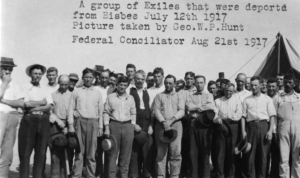
On July 12, 1917, in the midst of a copper miners’ strike, some 1,186 men in Bisbee, Arizona, were rounded up by vigilantes, loaded into filthy boxcars, and deported from the town under armed guard. Many of those seized were not strikers. (Some of them were not even miners.) The families of those deported were left to fend for themselves, as best they could — or starve.
The confrontation in Bisbee had been brewing for a long time. Arizona had been the home to huge copper mining operations for years. After World War I began in 1914, the price of copper climbed, and the copper companies had reaped enormous profits.
While the price of copper had almost tripled since the beginning of the war, working conditions had not improved. Bisbee had 5,000 miners working around the clock during World War I, but a rise in inflation had increased living expenses and eroded the gains workers had made in wages.
Before 1917, union activity in Bisbee had been squashed repeatedly. Between 1906-07, about 1,200 men were fired for supporting a union. In 1907, a strike was defeated, and the strikers were denounced as “un-American” and “alien agitators.” The copper companies began to employ large numbers of Mexican and Southern European workers, forcing them to work the lowest-paid and most unsafe jobs.
In 1916, the International Union of Mine, Mill, and Smelter Workers enrolled 1,800 miners in Bisbee. The Industrial Workers of the World also sent organizers to Bisbee. The IWW was very successful in recruiting Bisbee’s Mexican workers, who were routinely given low-paying jobs outside of the mines. It also made headway in recruiting Southern European immigrants, immigrants who were allowed in the mines but given lower-paying jobs.
WORKERS’ DEMANDS
On June 24, 1917, the IWW presented the Bisbee mining companies with a list of demands. It included improvements in safety and working conditions (such as requiring two men on each machine), and an end to discrimination against union workers and foreign-born and minority workers. It also demanded a flat wage system to replace the sliding scales tied to the market price of copper.
The copper companies refused all the IWW demands, using the fact that the United States had entered World War I months earlier as an excuse to resist changing anything. By June 27, about half of Bisbee’s workforce was out on strike.
One rumor claimed that the unions had been infiltrated by pro-German elements. Another charged that weapons and dynamite had been stockpiled around Bisbee for the purpose of sabotage.
VIGILANTES
Local businessmen resurrected an anti-union organization called the Citizens’ Protective League, which had been created during a previous labor dispute. It was put under the control of Sheriff Henry Wheeler. An organization of miners loyal to the companies – called the Workman’s Loyalty League – was also formed.
On July 11, secret meetings of the two vigilante groups were held to discuss ways to deal with the strike. John C. Greenway, the general manager of the Calumet and Arizona Mine, was present at one of these meetings. At two o’clock in the morning on July 12, calls were made to Loyalty League members as far away as Douglas, Arizona. By 5 a.m., about 2,000 deputies had assembled. All wore white armbands, the symbol of opposition to the strike.
At 6:30 a.m., Sheriff Henry Wheeler gave the orders to begin the round-up. Throughout Bisbee, men were taken from their beds, their houses, and the streets. The vigilantes were instructed to avoid violence, but had been armed with an arsenal widely believed to have been provided by Walter P. Douglas, the president of Phelps-Dodge Corporation. Later, there would be reports of beatings, robberies, vandalism, and abuse of women.
Not everyone went peacefully. Jim Brew, a militant miner active in the IWW, was asleep at his boardinghouse when vigilantes forced their way in. He warned them that he would shoot them if they persisted. When Orson McRae, an unarmed shift boss who was accompanying the five vigilantes, entered Brew’s room, Brew shot and killed him. The vigilantes immediately shot and killed Brew. These were the only two deaths that occurred during the deportation. Phelps-Dodge gave McRae an elaborate funeral; Brew’s body was buried at midnight in the Elks section of Bisbee’s Evergreen Cemetery.
The vigilantes marched their prisoners two miles to the Warren Ballpark. There, they were surrounded by armed Loyalty Leaguers and urged to quit the strike. Anyone willing to put on a white armband was released.
At 11 a.m., a train arrived. The 1,186 prisoners were loaded on to boxcars that were inches deep in manure. (Also boarding were 186 armed guards.) A machine gun was mounted on top of the train. The news of what was happening was denied to the world when an official of one of the copper companies seized the Western Union telegraph office in Bisbee by force and held up an Associated Press dispatch.
The train headed east, from Bisbee, Arizona, to Columbus, New Mexico. There, it was turned back because there were no accommodations for so many men. On the return trip, the train stopped at Hermanas, New Mexico, where the men were abandoned. A later train brought water and food rations, but the deportees were left without shelter until July 14, when U.S. soldiers arrived. The soldiers escorted the men to facilities in Columbus. Many were detained for several months.
While all this was unfolding, authorities in Bisbee mounted guards on all roads into town to ensure that no deportees returned and to stop new “troublemakers” from entering. (They also established a kangaroo court in Bisbee to try other people designated as allegedly disloyal to the mine owners. These suspects also faced possible deportation.)
THE AFTERMATH
Several months later, President Woodrow Wilson set up the Federal Mediation Commission to investigate the Bisbee Deportation. The commission ruled that no federal laws applied to the situation, and so it could do nothing. It referred the matter to the state of Arizona, recommending that such activities as those that went on in Bisbee be made criminal by federal statute. (The commission did rule that the copper companies were at fault in the deportation, not the IWW.)
In the end, the state of Arizona took no action against the copper companies. About 300 deportees brought civil suits against the El Paso and Southwestern Railroad and the copper companies. None came to trial because of out-of-court settlements. Lawsuits were also filed in state court against 224 vigilantes. Of these, the only one that went to trial ended in a “not guilty” verdict in favor of the vigilante. The rest of the cases were dismissed.
The 1,186 men who were forced into cattle cars that summer were a diverse group. There were 167 men who were U.S. citizens and 229 Mexican citizens. The rest came from every corner of the globe. In total, there were workers from 33 different countries among the deportees. This included many countries in Southern and Eastern Europe, such as Croatia, Montenegro, Serbia, Greece, Slovenia, Poland, Russia, Lithuania, and Armenia.
The facts show that the deportees did not fit the stereotype of “wild-eyed radicals” at all. Some 773 of the 1,186 men owned at least a little property; 355 had registered for the draft; 169 had purchased Liberty Bonds; 71 had taken out first and final citizenship papers; and 241 had taken out first citizenship papers.
The Bisbee Deportation set the cause of labor back decades; the scars still have not healed. Faced with such a tragedy, we have a responsibility to extract every lesson we can. The colossal injustice of July 12, 1917 shows how deep the impulse toward vigilante violence is in this country – and how brutally that impulse expresses itself. It points out how fragile civil liberties become in times of war.
It proves that attacks on the most vulnerable end up becoming attacks on all of us.
Those lessons from the beginning of the previous century are essential to remember today. After all, the attacks on the vulnerable continue – and the spirit of vigilante violence is very far from dead in the Arizona desert.
by Chris Mahin
https://www.youtube.com/watch?v=E_Ysa0eWqnE